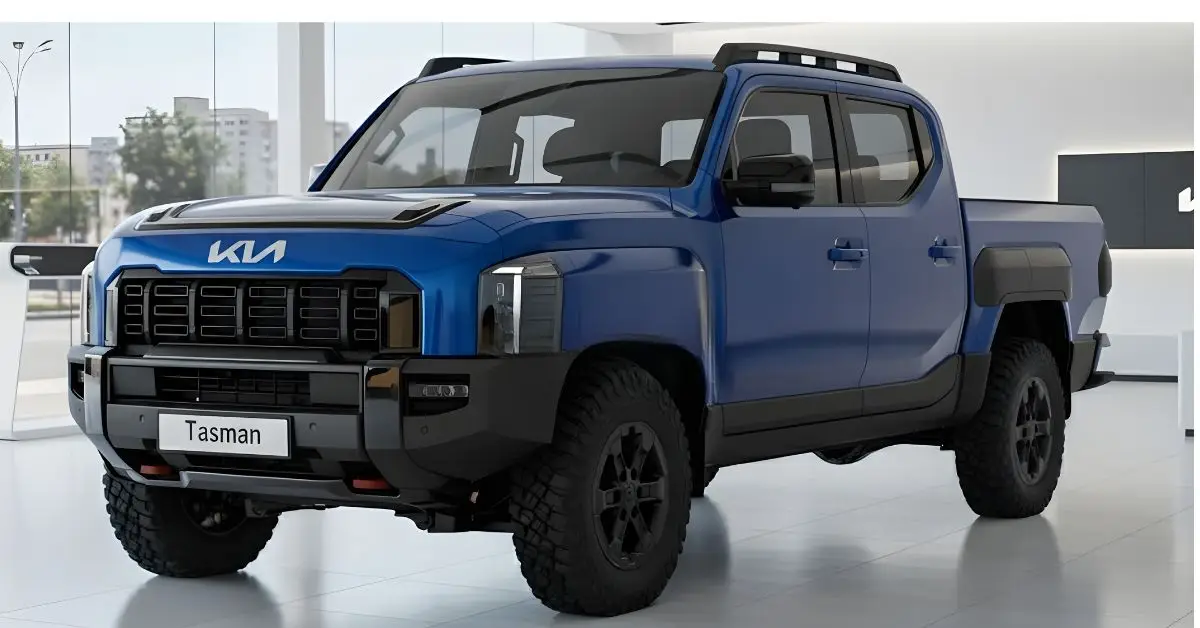
The Kia Tasman 2026 will mark a major turning point for Kia, a brand that has transformed from a value-focused manufacturer into a bold, design-driven global powerhouse. For decades, the pickup truck market was dominated by legacy players from the United States, Australia and Japan. No one expected Kia—a company known for its SUVs and electric mobility—to enter this segment with such confidence. Yet here we are, on the brink of witnessing the launch of the Kia Tasman, a lifestyle-performance pickup that is already generating intense hype even before its global debut.
| Feature | Details |
|---|---|
| Body Type | Body-on-Frame Pickup Truck |
| Launch Year | 2026 (Global Debut) |
| Engine Options | Turbo-Diesel, Turbo-Petrol, Hybrid (Expected) |
| Drivetrain | 4WD / RWD (Market Specific) |
| Platform | All-new Ladder Frame Architecture |
| Seating | 5-Seater Dual-Cab (Primary Variant) |
| Target Markets | Australia, South Korea, Middle East, Europe |
| Key Strengths | Rugged Design, Off-road Capability, Premium Interior |
| Expected Rivals | Toyota Hilux, Ford Ranger, Nissan Navara |
The Kia Tasman is not just another utility truck. It is a statement of ambition, a demonstration that Kia intends to challenge traditional pickup markets with a fresh, contemporary philosophy. Born from the brand’s rugged “Opposites United” design language, engineered with global markets in mind and honed for the world’s harshest terrains, the Tasman is shaping up to be one of the most important vehicles in Kia’s modern portfolio.
The Kia Tasman matters for many reasons. It is Kia’s first-ever proper body-on-frame pickup, meaning the company built an entirely new platform from the ground up. It represents Kia’s expansion into the lucrative lifestyle-truck category—something brands like Ford, Toyota, Nissan and Isuzu have capitalised on for years. And perhaps most importantly, it reflects Kia’s desire to diversify its global lineup, especially for markets like Australia, South Korea, the Middle East, Europe and potentially even North America.
In a world where pickup trucks are no longer just work machines but symbols of adventure, freedom and power, the Kia Tasman arrives at the perfect time. The early prototypes, spy shots and leaked details already paint a compelling picture of a truck engineered for durability and designed with unmistakable Kia flair. With a projected 2026 launch, the stage is set for Kia to reinvent its identity once again.
Design That Blends Muscle With Modernity
The Kia Tasman stands out instantly, thanks to its assertive proportions and bold lines. Kia’s designers knew the Tasman needed to look tough, rugged and capable—not like a lifted SUV pretending to be a truck, but a true body-on-frame warrior built for punishment. At the same time, they wanted it to look modern, sculpted and sophisticated enough to appeal to buyers who want their pickup to double as a lifestyle symbol.
The front fascia carries a variation of Kia’s new tiger-face identity but reimagined for a truck. Sharp LED DRLs, vertical light elements, a wide muscular grille and a squared-off bumper give the Tasman a confident, aggressive expression. It looks ready for battle, almost like a sci-fi off-roader engineered for the future. Even from a distance, it has a strong road presence that feels closer to Ford Ranger Raptor or Toyota Hilux GR Sport territory rather than a simple entry-level utility truck.
Along the side, the Tasman’s body showcases crisp, clean surfaces combined with broad wheel arches and high ground clearance. Those arches will likely house large all-terrain tyres, especially in off-road-focused variants. The cabin proportions suggest both dual-cab and single-cab configurations, but the global priority is clearly lifestyle and family buyers who want space, comfort and versatility.
The rear of the Tasman is equally bold. The full-width tail-lamp signature carries Kia’s futuristic lighting philosophy. The tailgate design appears chunky and robust, with integrated steps or grab points for ease of access. Kia understands its market well: buyers want usability, but they also want something that looks premium when parked at a campsite, beach or mountain trail.
Overall, the Tasman’s design is shaped by dual priorities. It must be tough enough for hard work, yet refined and stylish for everyday life. Kia seems to have achieved this balance exceptionally well, creating what might become one of the best-looking pickups in the world when it launches.
Interior That Combines SUV Luxury With Pickup Practicality
If early reports and Kia’s design philosophy are anything to go by, the Tasman’s interior will set new benchmarks for lifestyle pickups. Kia has consistently delivered some of the best cabin designs in the mass market, and the Tasman is expected to follow suit by blending rugged practicality with premium comfort.
One of the biggest advantages Kia holds is its mastery of intuitive cabin layouts. Expect the Tasman to feature a wide digital display setup similar to the EV6 or Sorento, merging a digital instrument cluster with a central infotainment touchscreen. Kia’s software has matured significantly, offering fast, fluid UI and rich functionality, including navigation, off-road data, camera views and connected features.
Materials will depend on the variant, but Kia is expected to offer soft-touch surfaces, brushed metals and durable fabrics designed to handle rugged use. The seats will likely be wide, comfortable and supportive, especially for long-distance drives—something Kia excels at. Dual-cab variants will offer generous legroom in the second row, making the Tasman a practical family truck and not just a work tool.
At the same time, Kia understands the utility aspect of pickups. The cabin will likely have multiple storage points, flexible cubby spaces, under-seat storage options, waterproof or mud-proof materials in off-road variants, and modular accessories that let owners customise the interior for adventure.
The Tasman’s interior philosophy seems clear: it will be as premium and intuitive as a Kia SUV while offering the rugged functionality expected from a truck built for tough environments. This hybrid personality is what will make the Tasman stand out in markets where buyers want performance and luxury wrapped in a single versatile package.
Engine Options That Balance Power, Efficiency and Capability
While Kia has not officially revealed the Tasman’s powertrain suite, industry leaks and platform data strongly suggest multiple configurations. Given its global ambitions, the Tasman will likely come with diesel, petrol and hybrid (and possibly future electric) options depending on the market.
For regions like Australia, New Zealand, Africa and parts of Southeast Asia—where the Tasman will be a major competitor—a strong turbo-diesel engine is expected. This diesel powertrain will most likely be a 2.2-litre or larger unit borrowed from Kia’s existing lineup but tuned for higher torque and towing capacity. Kia understands that diesel remains the heart of the global utility market, and the Tasman must deliver torque, fuel efficiency and durability to compete with rivals like the HiLux, Ranger and Navara.
In other markets, especially North America and Europe, a petrol turbo engine is highly likely. Kia’s 2.5-litre turbocharged four-cylinder, which already powers several SUVs, could become the Tasman’s core petrol offering. With strong low-end power, clean emissions and impressive refinement, this engine could appeal to lifestyle and family buyers who want more performance without the noise and ruggedness of diesel.
Hybridisation is equally possible. Kia has invested heavily in hybrid and plug-in hybrid technology, and integrating such systems into a pickup truck would help the Tasman stand out in global markets pushing toward electrification. A strong hybrid setup could give the Tasman instant torque, lower fuel consumption and smoother daily drivability.
Kia’s future plans also include full-electric trucks under the company’s EV roadmap, so the Tasman platform will likely be engineered with electrification in mind. Whether a Tasman EV arrives in 2026 or later remains uncertain, but the foundation is clearly being laid.
What we know for sure is that Kia will not enter the pickup world with underpowered engines. The Tasman must prove itself as a true work-capable truck, and Kia is unlikely to compromise on performance.
A Proper Body-on-Frame Platform Built for Real Work
The Tasman marks Kia’s first-ever venture into a true pickup frame. Instead of modifying an existing SUV platform, Kia developed a dedicated body-on-frame architecture capable of handling heavy loads, serious off-road stresses and global regulatory requirements.
This ladder-frame platform is expected to rival the Toyota IMV, Ford T6 and Nissan F-Alpha platforms in terms of strength and versatility. Kia’s chassis engineering teams reportedly tested the Tasman in extreme conditions, from deserts to mountainous regions, to ensure long-term durability.
Expect the Tasman to offer strong towing and payload ratings, making it suitable not just for urban buyers but also for tradespeople, adventure enthusiasts and small-business owners. Kia knows that credibility in the pickup world depends on numbers and real-world toughness, not just design flair.
Suspension setups will vary by variant. Workhorse models will likely get leaf springs, while lifestyle or off-road trims could feature multi-link setups for improved ride comfort. Kia will probably offer four-wheel-drive as standard in many global markets, alongside low-range gearing for harsh terrain.
As a global lifestyle-truck contender, the Tasman must do more than look the part—it must prove its worth in real-world durability tests. So far, early assessments suggest Kia is heading in the right direction.
Off-Road Capability That Matches Its Rugged Image
A pickup truck cannot succeed today without genuine off-road credibility, especially in markets like Australia, South Africa and the Middle East. The Tasman will likely come with proper 4WD hardware, including locking differentials, advanced traction control systems, reinforced underbody protection and multiple terrain modes.
Kia has been studying its competitors closely, and early test mules indicate a truck designed for deep off-road engagement. High ground clearance, large approach and departure angles, and aggressive wheel options all point to serious capability.
Kia’s AWD and terrain management systems are already strong across the Sorento and Sportage lineups. Applied to the Tasman’s larger, more capable chassis, these systems could give the truck excellent performance in sand, mud, snow and rocky environments.
The Tasman’s off-road variants could become popular among weekend adventurers, campers and urban buyers who want an SUV’s comfort with a truck’s toughness.
Technology That Elevates the Pickup Experience
Modern pickup buyers expect the same level of technology found in premium SUVs, and Kia will ensure the Tasman meets this demand. Expect next-generation connectivity features, over-the-air updates, full-digital instrumentation and advanced ADAS systems, including highway driving assistance.
Kia is known for offering one of the best infotainment experiences in the industry, and the Tasman will benefit from large high-resolution screens, seamless smartphone integration and intuitive UI design.
Features like 360-degree camera, trailer assist mode, off-road visualisation, and blind-spot monitoring will further elevate the Tasman’s practicality and daily usability. The truck will not just be a workhorse—it will be a tech-savvy companion for modern lifestyles.
Conclusion – A Global Challenger With Serious Potentia
The Kia Tasman 2026 is shaping up to be one of the most ambitious moves in Kia’s global expansion story. With rugged design, advanced interiors, strong powertrain possibilities, a true body-on-frame architecture and modern technology, the Tasman has all the ingredients needed to disrupt the global lifestyle pickup market.
Whether it becomes a top seller remains to be seen, but one thing is certain: Kia is entering the pickup space with bold intent, engineering expertise and design confidence. The Tasman is not a half-hearted experiment. It is a carefully calculated, globally focused product meant to compete with giants and carve a new identity for Kia.
FAQs
1. When will the Kia Tasman launch?
The Kia Tasman is expected to make its global debut in 2026.
2. What engines will the Tasman offer?
It is expected to get turbo-diesel, turbo-petrol and possibly hybrid options.
3. Is the Kia Tasman a proper pickup?
Yes, it is built on an all-new body-on-frame ladder platform.
4. Will the Tasman come to Australia?
Yes, Australia is one of its primary target markets.
5. What trucks will the Tasman compete with?
It will rival the Toyota Hilux, Ford Ranger and Nissan Navara.
