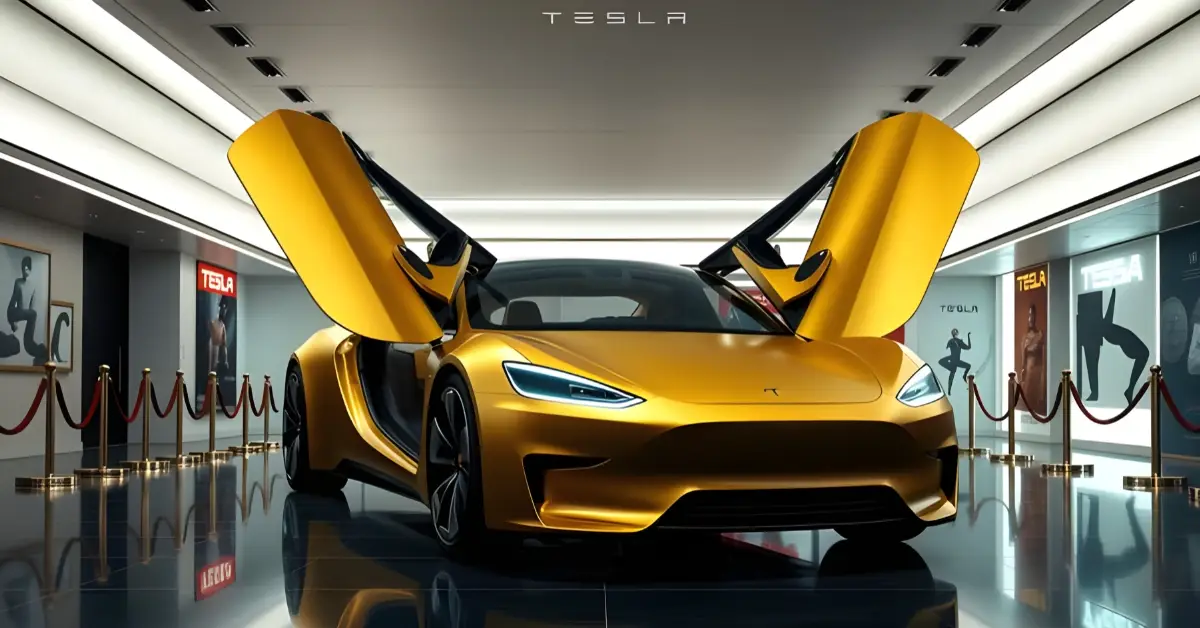
The automotive industry stands at the brink of a revolutionary transformation, and Tesla is leading the charge with its groundbreaking Tesla Cybercab. This purpose-built autonomous robotaxi represents Elon Musk’s vision of a future where transportation is safer, more affordable, and completely driverless. The Tesla Cybercab made its dramatic debut at the “We, Robot” event in October 2024, where 20 prototypes provided attendees with their first glimpse of what autonomous urban mobility could look like. With production scheduled to begin in April 2026 and a target price below $30,000, the Tesla Cybercab promises to democratize personalized transportation and fundamentally change how people move through cities worldwide.
Introduction to the Tesla Cybercab Revolution
The Tesla Cybercab represents more than just another electric vehicle in Tesla’s expanding lineup. It embodies a complete reimagining of urban transportation, designed from the ground up specifically for autonomous operation. Unlike Tesla’s existing vehicles that can operate in both manual and autonomous modes, the Tesla Cybercab is the company’s first vehicle created exclusively for self-driving service. This bold approach reflects Tesla’s confidence in its Full Self-Driving technology and signals a new era in the company’s strategy to dominate the emerging robotaxi market.
At the Warner Bros. Studios unveiling event, CEO Elon Musk arrived on stage in a Tesla Cybercab, immediately demonstrating the vehicle’s capabilities. The event showcased the Tesla Cybercab operating autonomously around the studio lot, giving attendees hands-on experience with the technology that Tesla believes will revolutionize transportation. Musk’s statement during the event captured the company’s ambition perfectly when he declared that the Tesla Cybercab is not just another car but a new mode of transportation designed from the ground up for efficiency, safety, and sustainability.
Design Philosophy and Exterior Features
The Tesla Cybercab features a striking design that immediately sets it apart from any vehicle currently on the road. The exterior draws inspiration from the Cybertruck’s futuristic aesthetic while incorporating flowing curves and lines that give the Tesla Cybercab a unique identity. The compact two-door design features a teardrop silhouette that prioritizes aerodynamic efficiency, enabling the vehicle to achieve impressive range figures despite its relatively small battery pack.
One of the most distinctive features of the Tesla Cybercab is its butterfly doors, which lift upward to provide easy access to the cabin. These doors open automatically as passengers approach, eliminating the need for traditional door handles. The design decision reflects the Tesla Cybercab’s purpose as a robotaxi, where passengers need seamless entry and exit without fumbling with door handles or controls. The production-ready versions spotted on public roads feature refinements including frameless windows, a larger front splitter, updated lighting, and a more polished exterior compared to the original concept.
The Tesla Cybercab notably lacks several features found on traditional vehicles. There is no rear window, similar to the Polestar 4, and no external charging port is visible on the prototypes. The vehicle relies entirely on cameras and sensors for navigation and obstacle detection, with roof-mounted components providing 360-degree awareness of the surrounding environment. The aluminum body panels finished in silver give the Tesla Cybercab a premium appearance while keeping manufacturing costs lower than the stainless steel construction used on the Cybertruck.
Interior Design and Passenger Experience
Step inside this revolutionary robotaxi, and you immediately notice what is missing rather than what is present. The vehicle features no steering wheel and no pedals, reflecting its exclusive focus on autonomous operation. This radical departure from traditional vehicle design creates significantly more interior space and transforms the cabin into something closer to a small lounge on wheels than a conventional car.
The minimalist interior continues Tesla’s design philosophy taken to its logical extreme. The dashboard is flat and horizontal, dominated by a large 20.5-inch center display that serves as the primary interface for passengers. This screen displays trip progress, provides entertainment options including movies, television shows, and video games, and allows passengers to interact with the vehicle’s systems. The screen is notably larger than the 15-inch displays found in the Model 3 and Model Y, providing an enhanced viewing experience during rides.
The seating arrangement accommodates two passengers in wide, flat-backed seats that resemble comfortable home chairs rather than traditional automotive seats. Tesla designed these seats specifically for urban travel, where passengers will not experience significant lateral forces that require contoured sides for body restraint. The seats are upholstered in leatherette material that is easily washable, an important consideration for a vehicle intended for public use. Heated seats are included, though ventilation is not available in current prototypes.
Between the two seats sits a central armrest with cup holders beneath, and door control buttons are positioned conveniently for passengers. The doors close automatically when passengers buckle their seatbelts, though manual controls remain available. Tesla has deliberately kept the interior simple and easy to clean, anticipating that the robotaxi will need regular sanitization between rides to maintain hygiene standards for public transportation.
Autonomous Driving Technology
The heart of this revolutionary vehicle is its advanced autonomous driving system, which represents the evolution of Tesla’s Full Self-Driving technology. The Cybercab uses the same computer systems and sensors that power FSD in current Tesla vehicles like the Model 3 and Model Y, but with enhanced computing power and optimization for fully autonomous operation. Unlike current Tesla vehicles where FSD requires driver supervision, this robotaxi is designed to operate without any human intervention whatsoever.
Tesla’s approach to autonomous driving differs significantly from competitors like Waymo and Zoox, which rely heavily on expensive LiDAR sensors. The vehicle uses a camera-based system combined with artificial intelligence to perceive and navigate its environment. Elon Musk has consistently argued that cameras alone, combined with sophisticated AI processing, can achieve safer autonomous driving than sensor fusion approaches used by competitors. The AI system has been trained on billions of miles of data collected from Tesla vehicles operating with supervised FSD worldwide.
During the unveiling event, Musk made the ambitious claim that autonomous vehicles could be 10 to 30 times safer than human-driven cars. This safety advantage, if realized, would address one of the primary concerns surrounding autonomous vehicle adoption. The company has already begun testing the Tesla Cybercab on public roads, with vehicles spotted driving in Austin, Texas, and California wearing manufacturer plates and undergoing real-world validation of their autonomous capabilities.
Technical Specifications and Performance
The Tesla Cybercab delivers impressive efficiency through its purpose-built design. The vehicle features a 35 kWh battery pack that provides an estimated range of 200 miles (320 kilometers), with some reports suggesting the production version could achieve up to 300 miles with optimized aerodynamics. Tesla reports remarkable efficiency figures of 5.5 miles per kWh, making the Tesla Cybercab one of the most efficient electric vehicles ever produced.
The compact dimensions and lightweight construction contribute significantly to the Tesla Cybercab’s efficiency. By eliminating traditional driving controls, the vehicle saves weight and complexity while freeing space for passengers and cargo. The roof is constructed from polyurethane panels with embedded pigmentation rather than traditional metal or glass, further reducing weight while maintaining structural integrity.
| Specification | Details |
|---|---|
| Seating Capacity | 2 Passengers |
| Battery Capacity | 35 kWh |
| Estimated Range | 200-300 miles |
| Efficiency | 5.5 mi/kWh |
| Target Price | Under $30,000 |
| Charging | Inductive (Wireless) |
| Display Size | 20.5 inches |
| Production Start | April 2026 |
| Doors | Butterfly Style |
| Steering Controls | None (Fully Autonomous) |
Inductive Charging Innovation
One of the most innovative features of this autonomous vehicle is its exclusive use of inductive charging technology. The robotaxi will not feature a traditional NACS charging port found on other Tesla vehicles. Instead, the vehicle charges wirelessly through an inductive charging pad, representing the first fleet-scale implementation of this technology in electric vehicles.
Tesla has been developing wireless charging technology for several years and acquired Wiferion, a wireless charging specialist, to accelerate development. The inductive charging system achieves efficiency well above 90 percent, making it practical for commercial fleet operations. This technology eliminates the need for drivers or attendants to physically connect charging cables, perfectly aligning with the fully autonomous operation concept.
The charging infrastructure will be centered around “Cybercab Hubs” where vehicles can autonomously navigate to charge and undergo cleaning between rides. These hubs will feature robotic cleaning systems that sanitize the interior using automated vacuum and scrubbing equipment, ensuring passengers always enter a clean cabin. The hub concept addresses practical concerns about maintaining a fleet of autonomous vehicles operating continuously in urban environments.
Production Timeline and Manufacturing
Tesla has confirmed that Tesla Cybercab production will begin at Gigafactory Texas in April 2026, with CEO Elon Musk announcing this timeline during the company’s 2025 Annual Shareholder Meeting. The company is taking an unconventional approach to manufacturing that Musk describes as closer to high-volume consumer electronics production than traditional automotive manufacturing. Tesla aims to achieve cycle times of approximately ten seconds per unit, enabling potential annual production volumes of up to 5 million vehicles when multiple factories reach full capacity.
The ambitious production goals reflect Tesla’s confidence in the Tesla Cybercab’s market potential. The company has stated an annual production target of 2 million Cybercabs per year when several factories operate at full design capacity. Recent images shared by Tesla show a pilot Cybercab production line, confirming that preparations for manufacturing are well underway. Initial volumes are expected to be modest as Tesla refines production processes, but the intent is clear that the Tesla Cybercab is transitioning from concept to production reality.
Production-ready Tesla Cybercabs have already been spotted on public roads in Austin and California, featuring refinements over the original prototypes. These updates include a new frameless window design, a more refined front bumper, production-spec lighting, two windshield wipers instead of the prototype’s single blade, and increased interior legroom. Some test vehicles have even been observed with conventional steering wheels, likely to accommodate testing requirements or potential regulatory variations.
Pricing Strategy and Market Positioning
Tesla has announced a target price of under $30,000 for the Tesla Cybercab, positioning it as an affordable option both for individual purchasers and fleet operators. This price point is remarkable considering the advanced autonomous driving technology included in every vehicle. Tesla achieves this competitive pricing by eliminating expensive components like steering mechanisms, pedal assemblies, and driver-focused features, while leveraging simplified manufacturing processes and the economies of scale from high-volume production.
In a somewhat surprising move, Tesla announced that the Tesla Cybercab will be available for individual purchase, not just fleet operators. This opens possibilities for entrepreneurs to operate their own small robotaxi fleets or for individuals to own autonomous vehicles for personal use. The under $30,000 price tag makes the Tesla Cybercab competitive with entry-level electric vehicles while offering significantly more advanced autonomous capabilities.
The economic case for the Tesla Cybercab extends beyond purchase price. Tesla projects operating costs as low as $0.20 per mile for robotaxi service, compared to approximately $1.00 per mile for city bus transportation. Musk emphasized that traditional personal vehicles sit unused approximately 158 hours per week out of 168 total hours, representing massive inefficiency. An autonomous Tesla Cybercab operating as a robotaxi could see utilization rates five to ten times higher than personal vehicles, dramatically increasing the value generated per vehicle.
Regulatory Challenges and Approval Process
The path to widespread Tesla Cybercab deployment faces significant regulatory hurdles. Currently, Tesla’s Full Self-Driving technology operates as a Level 2 system requiring driver supervision, but the Tesla Cybercab is designed for completely unsupervised operation. This fundamental difference means Tesla must obtain entirely new regulatory approvals before the Tesla Cybercab can legally operate as intended on public roads.
Tesla is already testing robotaxi services in Austin using Model Y vehicles with supervised Full Self-Driving, building the safety data and operational experience needed to support regulatory applications. The company hopes to receive approval for unsupervised FSD operation in California and Texas during 2026, which would enable the Tesla Cybercab to begin commercial service. European regulatory approval for supervised FSD is expected as early as February 2026, paving the way for eventual Tesla Cybercab deployment in international markets.
When asked about potential mismatches between production timelines and regulatory approvals, Musk expressed confidence that the rate of regulatory approval will roughly match the rate of Tesla Cybercab production. He pointed to favorable accident statistics from supervised FSD operation and the successful deployment of competitor services like Waymo as factors helping to pave the way for broader autonomous vehicle acceptance. However, industry observers note that the assumption of timely approvals covering sufficient geographic areas to justify mass production remains uncertain.
Competition in the Robotaxi Market
The autonomous robotaxi market is becoming increasingly competitive as multiple technology companies race to deploy commercial services. Waymo, owned by Google parent company Alphabet, currently operates commercial robotaxi services in several US cities using vehicles equipped with expensive LiDAR sensors and operating within carefully mapped geographic areas. These vehicles have accumulated millions of miles of autonomous driving experience and demonstrated the viability of driverless transportation in urban environments. Amazon-owned Zoox has developed a purpose-built autonomous vehicle with bidirectional capability, though it has not yet launched commercial service at scale.
Tesla’s competitive advantage lies in its vast fleet of consumer vehicles already collecting real-world driving data that trains the company’s autonomous driving algorithms. With 6.9 billion miles of supervised FSD data, Tesla claims its systems achieve substantially better safety performance than human drivers. This data advantage, combined with lower production costs and a simpler sensor suite, could enable Tesla to scale robotaxi service more rapidly than competitors relying on expensive sensor technology and manual mapping processes.
The competitive landscape is evolving rapidly in China, where companies like Huawei and Zeekr have announced charging systems and autonomous driving platforms that could support robotaxi operations. Chinese manufacturers are investing heavily in autonomous vehicle technology, creating potential competition for any company seeking to establish global robotaxi services. The race to deploy commercial autonomous transportation services is intensifying, making production timelines and regulatory approvals increasingly important for maintaining competitive positioning in this transformative market segment.
Safety Considerations and Public Trust
Building public trust in autonomous vehicles represents one of the most significant challenges facing the robotaxi industry. High-profile accidents involving autonomous vehicles have created skepticism among potential users, and overcoming this skepticism requires demonstrating consistently safe operation over extended periods. Tesla’s approach with the Cybercab involves leveraging billions of miles of supervised FSD data to validate safety claims before transitioning to unsupervised operation.
The company argues that autonomous driving technology will ultimately save lives by eliminating human errors responsible for the vast majority of traffic accidents. Human factors including distraction, impairment, fatigue, and poor judgment cause over 90 percent of crashes on today’s roads. An artificial intelligence system that never gets tired, never gets distracted, and can perceive its environment in all directions simultaneously has theoretical advantages over human drivers in many situations.
However, autonomous systems also face challenges that humans handle intuitively, including unusual road conditions, unexpected obstacles, and complex social interactions with pedestrians and other drivers. The technology must prove capable of handling edge cases safely before regulators and the public will accept fully driverless operation. Tesla’s strategy involves gradually expanding the operational capabilities of its autonomous systems while collecting data that demonstrates safety improvements over time.
Future Implications for Urban Transportation
The successful deployment of the Tesla Cybercab could fundamentally reshape urban transportation systems worldwide. If autonomous robotaxis prove safer and more cost-effective than human-driven vehicles, cities might see dramatic reductions in private car ownership, parking requirements, and traffic congestion. The Tesla Cybercab’s small footprint and ability to operate continuously could provide more efficient use of road infrastructure than the current model of individually owned vehicles sitting idle most of the time.
Environmental benefits could be substantial as well. The Tesla Cybercab’s all-electric powertrain produces zero direct emissions, and high utilization rates mean fewer vehicles are needed to serve the same transportation demand. The concentrated charging at Cybercab Hubs could integrate with renewable energy sources and grid storage systems, further reducing the carbon footprint of urban transportation.
Frequently Asked Questions
When will the Tesla Cybercab be available for purchase?
Tesla plans to begin production of the Tesla Cybercab in April 2026 at Gigafactory Texas. Initial availability may be limited to fleet operators and specific geographic regions where regulatory approval has been obtained, with broader consumer availability following as production scales up.
How much will the Tesla Cybercab cost?
Tesla has announced a target price of under $30,000 for the Tesla Cybercab. This price is intended to make the vehicle accessible for both individual buyers and fleet operators looking to deploy autonomous taxi services.
Can I drive the Tesla Cybercab manually?
No, the Tesla Cybercab is designed exclusively for autonomous operation and does not include a steering wheel or pedals. However, Tesla has indicated that versions with manual controls could be produced if regulatory requirements demand them in certain markets.
What is the range of the Tesla Cybercab?
The Tesla Cybercab features a 35 kWh battery providing approximately 200 miles of range, with some reports suggesting the production version could achieve up to 300 miles through optimized aerodynamics and efficiency improvements.
How does the Tesla Cybercab charge?
The Tesla Cybercab uses inductive wireless charging technology rather than a traditional plug-in port. Vehicles will charge at dedicated Cybercab Hubs where they can also receive automated cleaning and maintenance between rides.
Disclaimer
The information presented in this article is based on publicly available sources, official Tesla announcements, and industry reports as of December 2025. Readers should consult official Tesla communications and regulatory announcements for the most current information before making purchasing or investment decisions. This article is for informational purposes only and does not constitute financial, legal, or professional advice.
